First-hand trip record
About 13 min read
The journey, as it happened
Written from my trip notes and photographs. Changing rules and recommendations live on the dedicated planning pages.
- Travelled
- 2–15 August 2025
- On the road
- Musab + one travel companion
- Travel style
- Car + local driver
- Story reviewed
- 20 July 2026
There are countries you visit, and countries you enter. Kyrgyzstan falls into the second category. It's a country that doesn't let itself be consumed as a checklist. It demands presence, patience, and the willingness to let go of your plans when the mountains decide otherwise.
This is the record of the route we followed in August 2025, not an itinerary to copy literally. The dedicated planning pages hold the current route logic, safety context, practical checks, budget and packing list; this page stays with what the journey felt like.
For context, this account is told by me, Musab. I travelled with one companion, while local driver Anvar drove us on the overland stages. Beyond those roles and Anvar's first name, I leave the other people around the journey unnamed.
The Rhythm We Fell Into
Mornings began with light through the roof of a yurt or the sound of horses outside. Breakfast was bread, jam, kaymak, eggs and tea that seemed to refill itself. We moved while the light was soft, rested when the high-altitude sun became hard and watched the landscape change again toward evening.
After dinner there was rarely a programme to follow. We talked, read, looked at the stars and went to sleep early. Within a few days, daylight rather than a clock had become the rhythm of the trip.
Fourteen Days on the Road
What follows is a day-by-day account of what we saw, where the journey slowed down and which moments stayed with me. Whenever an operational detail matters, treat it as historical context from our trip and check the dedicated planning pages before making a decision.
Chapter 1 · Arrival & personal purpose
Day 1 August 2
Bishkek → Osh (same day return)
The Beginning
After arriving in Bishkek early in the morning, we flew on the same day to Osh, often described as one of the oldest cities in Central Asia.
This stop had personal significance. We visited a friend, which immediately gave the day a different weight than a standard travel stop. Even apart from that connection, Osh stayed with me: during our visit it felt slower and warmer than Bishkek, with Uzbek influence visible in the architecture and present in the food we ate.
Sulaiman-Too: The Sacred Mountain
We visited Sulaiman-Too, the sacred mountain that has played a spiritual and cultural role in the region for centuries. The site has been on the UNESCO World Heritage List since 2009. We walked up past caves used by pilgrims and rock surfaces marked with petroglyphs.
From the top, the city spread out below us. That sense of overview helped me understand why the mountain carries so much meaning.


Spiritual Dimension
We also visited the cemetery of Şeyh Salahuddin İbn-i Mevlana Siracüddin (k.s.), a place of peace and reflection. A visit like this coloured the journey in a way that is hard to explain. It connected me to something bigger than tourism.
In the evening we returned to Bishkek.
D2-3
Song-Kul
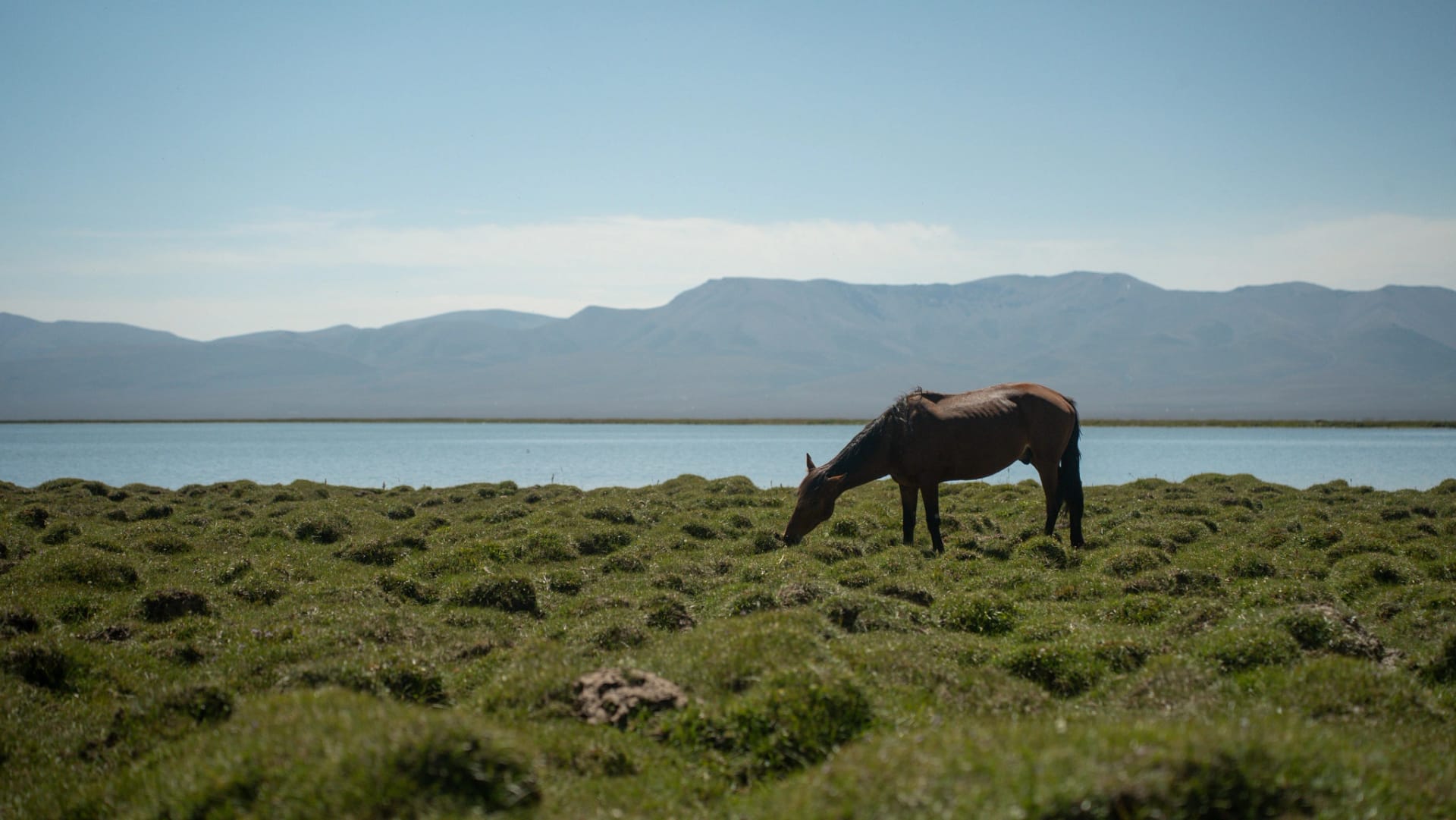
What stayed with me was the scale: at three thousand metres, the lake, grazing horses and an unbroken horizon made our first evening feel completely removed from the road behind us.
Chapter 2 · The first high country
Day 2 August 3
Bishkek → Song-Kul
The Transformation
On our route, the transition from the city to open landscape felt abrupt and impressive. We drove through increasingly narrow valleys, climbed via hairpin turns and, somewhere along the way, everything changed.
The trees disappeared. The air felt thinner and clearer. The colours shifted to unfamiliar shades of green and brown. Then, after a final pass, the landscape opened up and Song-Kul came into view.
The lake sat at 3,016 metres, surrounded by rolling hills where yurts stood scattered like white dots. Horses grazed freely, the wind barely let up and the silence still felt overwhelming.


Arrival at Altitude
The first hours at Song-Kul felt strange. We were tired from the journey, but it was more than that: our route had taken us directly from Bishkek at about 750 metres to sleep at 3,016 metres on the same day.
That is what we did in August 2025, not the ascent profile I would recommend copying. The current Practical Info explains why a staged ascent or lower-sleeping alternative matters and which symptoms must never be pushed through.
The Yurt
Our yurt had mattresses on the floor, thick blankets, colourful wall coverings and a stove that was lit in the evening. There was no mains electricity. The contrast was memorable: generous warmth under the blankets, cold air outside and a sky without light pollution.
Day 3 August 4
Song-Kul (rest day)
A Day of Nothing
We spent a full day at Song-Kul. No transfer, no rush, no agenda.
It was the kind of day I would never have planned at home. No sight, no museum, no restaurant. Just horses, wind, clouds sliding over the lake and light that seemed different every hour.


Around the Camp
Around the yurts we watched cheese drying in the sun, horses being tended and the work of the day continuing around the weather. Our own day was deliberately small: walking near the lake, watching the light move across the water and accepting the cold, basic facilities as part of being there.
Song-Kul is not a place you consume. It's a place you enter, and that lets you in.
D4-5
Kel-Suu
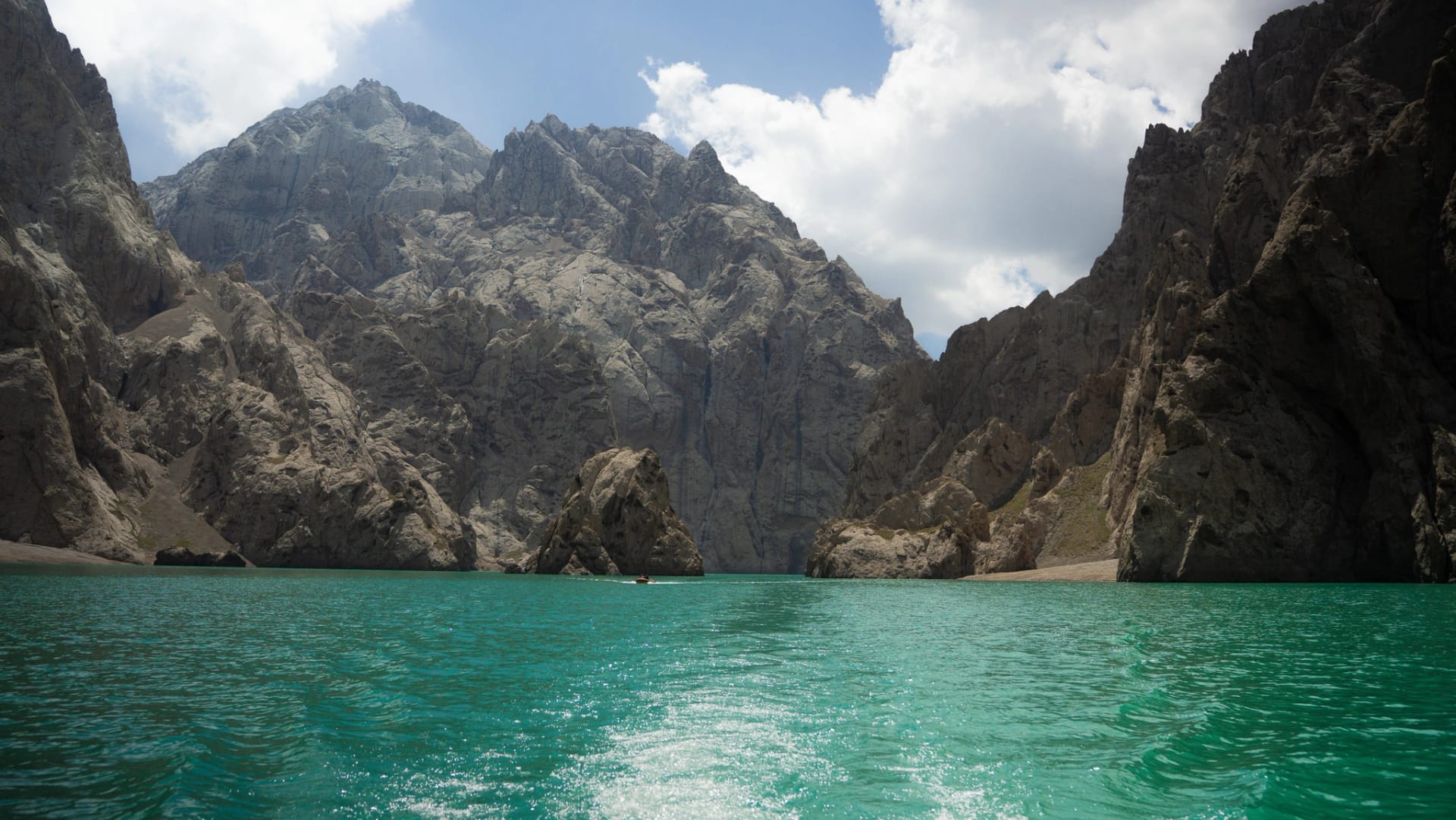
After hours on washboard road and the permit checks that were part of our August 2025 trip, we reached a nearly empty lake framed by cliffs catching the last light.
Chapter 3 · Remoteness & uncertainty
Day 4 August 5
Song-Kul → Kel-Suu
The Journey to the Border
From the open plateau we drove further toward Kel-Suu, a remote lake in the border region with China. For us, it was one of the most spectacular drives of the route. The landscape became rougher, the roads narrower and the villages sparser.
On the most remote stretch, we passed no shops or fuel stations and often had no phone signal. There were only mountains, rivers and, occasionally, a herder with a flock.


The Permit We Used
On our August 2025 trip, Kel-Suu still required a border-zone permit. Anvar arranged it for us and we carried our original passports through the checkpoint. That smooth experience belongs to this trip record, not to today's rules; the current recheck guidance lives in Practical Info.
Arrival
Our final kilometres to Kel-Suu followed a rough track through a riverbed. The conditions made clear how demanding the approach was. After a final bend, a narrow canyon opened onto turquoise water between red rock walls.
Our first reaction was silence. The landscape hardly looked real.
Day 5 August 6
Kel-Suu (exploration day)
A Day at the Lake
We spent a full day at Kel-Suu Lake. That morning the surface was almost mirror-smooth; by midday the wind had picked up and waves moved across the water.


The Colours of Kel-Suu
That day the water looked turquoise, while the canyon walls shifted between red and orange as the light changed. The contrast was almost unreal, and the scale only became clear when we stopped trying to frame it all at once. With a full day there, we could simply watch wind and light redraw the lake.
Day 6 August 7
Kel-Suu → Tash Rabat
Toward Tash Rabat
We drove further to Tash Rabat, a historic stone complex in a mountain valley. Our route crossed wide valleys and passes. After the drama of Kel-Suu, the drive felt quieter.
Along the way, we passed small villages, livestock and fields. From the car, the pace felt slower than on the previous stages.


Tash Rabat: The Stone Complex
Tash Rabat is a stone complex hidden in a mountain valley. Sources differ on its exact date and original function, so I treat the familiar caravanserai story as context rather than settled fact.
We moved between thick stone walls, through dome-shaped rooms and into a central hall. Inside, our footsteps echoed through the dark corridors and the air felt suddenly cool after the warmth outside. The dark interior and isolated setting gave the building its weight.
Staying at Tash Rabat
We stayed in a yurt camp nearby. The atmosphere felt different from Song-Kul: quieter, more remote and almost mystical. At night, we heard the wind move through the valley.
Chapter 4 · The south-to-east transition
Day 7 August 8
Tash Rabat → Bokonbaevo
Long Transfer Day
A long transfer day toward the south coast of Issyk-Kul. The road carried us through broad valleys, beside rivers and through villages, with the landscape doing most of the work while the hours accumulated.
We ended in Bokonbaevo, a village on the south side of Lake Issyk-Kul. For us, it functioned as a practical overnight base rather than a destination in itself.

Day 8 August 9
Bokonbaevo → Skazka Canyon → Jeti-Ögüz
Skazka Canyon (Fairy Tale Canyon)
The day began at Skazka Canyon, where the orange and red rock formations looked like another planet. "Skazka" means fairy tale in Russian, and the name suited what we saw.
The formations rose as towers, waves and shapes reminiscent of castles, dragons or whatever else our imagination made of them.
Jeti-Ögüz
We spent the afternoon at Jeti-Ögüz, where the red formations known as the "Seven Bulls" rose beside the road. It was less surreal than Skazka but more imposing in scale, and it marked a quiet visual transition toward the Karakol region.
D9-10
Altyn Arashan
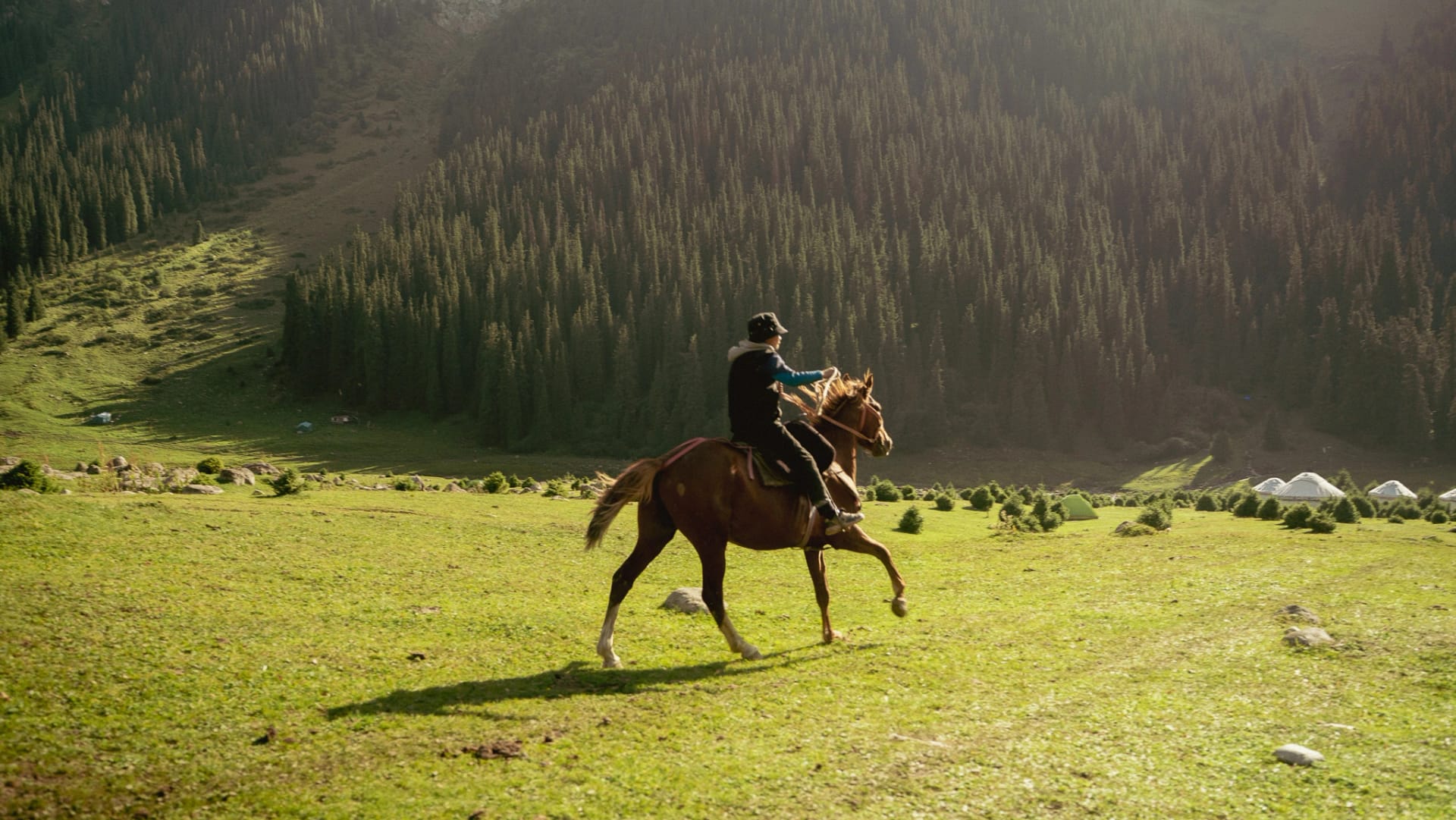
Golden grass, hot springs beside a cold river and horses grazing close to the guesthouse: after the rough approach, our two days in this valley felt like the point where the journey finally exhaled.
Chapter 5 · Rough access, recovery & return
Day 9 August 10
Jeti-Ögüz → Karakol → Altyn Arashan
Karakol: Last Town
Via Karakol, our final town stop before the mountains, we drove on to Altyn Arashan. For us it was the handover point between the ordinary road journey and the rough mountain approach.
The Road to Altyn Arashan
In Karakol we switched from the car to a Russian UAZ 4x4. Its utilitarian interior and high clearance hinted at the road ahead.

Our UAZ, arranged by Anvar, needed two to three hours for roughly 30 kilometres. The unpaved track was steep, full of potholes and crossed by water. The vehicle shook, bumped and climbed, and somehow that became part of the arrival.
Arrival in the Valley
The Altyn Arashan valley lies at about 2,600 metres, surrounded by coniferous forest and alpine meadows.
After the rough ride, arriving there felt like a relief. The air felt fresh, the river ran clear and the mountains towered around us.
Day 10 August 11
Altyn Arashan (rest day)
The Hot Springs
We spent a full day in the valley, centred on the hot springs. The baths ranged from rustic wooden huts to open pools. After days of driving and walking, the warm water and the absence of anywhere else to be were enough.


Hiking in the Valley
We chose a short walk along the river and through the forest. The focus was on recovery, not performance; for once, turning back early felt like the point rather than a compromise.
Simple Living
Our stay was simple: basic food, cold nights and little connectivity. And yet, or perhaps because of that, Altyn Arashan became one of the most restorative places on the route. We slept, read, walked a little and watched the stars.
Some places heal you not despite their simplicity, but because of it.
Day 11 August 12
Altyn Arashan → Karakol
Back to the Inhabited World
The UAZ ride back to Karakol felt shorter than the way there because we knew what to expect. In Karakol we took the afternoon and evening to recover.
Rest and Recovery
It was a functional day; not every moment needed to be epic. After a week of yurts, mountains and limited facilities, a night in a real bed with a hot shower was welcome.
Day 12 August 13
Karakol → Grigoriev Gorge → Cholpon-Ata
The North Coast of Issyk-Kul
We drove along the north coast of Issyk-Kul, with a stop at Grigoriev Gorge along the way. The gorge was green, with alpine meadows, waterfalls and shade. It felt like a pleasant change after the drier landscapes of the south side.


Grigoriev Gorge
We stopped briefly to walk, take photographs and absorb the shade. It was less dramatic than the major mountain days, but calming in a way that the journey needed by then.
Cholpon-Ata
We ended in Cholpon-Ata on the north coast of Issyk-Kul. Compared with our previous stops, it felt more visitor-oriented: beaches, resorts and restaurants. After almost two weeks in the mountains, that extra comfort felt almost decadent and gave us a gentle place to begin winding the trip down.
Day 13 August 14
Cholpon-Ata → Bishkek
The Last Ride
Our drive back to Bishkek followed the north coast of Issyk-Kul and then passed through Boom Gorge, where red rock walls rose beside the river. It felt like a worthy ending.

Bishkek: Closure
We arrived in Bishkek in the afternoon. The city felt different from when we had first arrived. After two weeks in the mountains, I saw it with different eyes.
Day 14 August 15
Departure (morning)
We left Bishkek in the morning.
Leaving Kyrgyzstan felt strange. What stayed with me was not only the photographs, but a sense of space, silence and a rhythm I had forgotten.
Reflections: What I Learned
01
Planning
I went to Kyrgyzstan with a route, a schedule, and expectations. The route stayed roughly intact. The schedule became looser by the day. The expectations were replaced by something else. Not better or worse, but more real.
02
Comfort
There's a limit to how long I want to sleep on a mattress on the floor, in the cold, without WiFi. That limit proved higher than I had thought. After a week I had adapted. By the end of the journey, I felt at home.
03
Time
At home I think in hours and deadlines. In Kyrgyzstan, I thought in daylight and seasons. The mornings gave us soft light, so we moved. When it grew dark, we stopped. Simple. Effective.
04
Connection
With little WiFi, I reached for my phone less. Without constant notifications, I stayed more present. The reduced input left room for thoughts that otherwise might not have surfaced.
05
Hospitality
In homes and guesthouses, people shared food, tea, a warm place to sleep, their time and their stories with us. Much of that generosity arrived without asking for anything in return.
Visual Highlights
A curated selection from the journey
I share all my travel photos and stories on Instagram. Follow along for daily highlights and behind-the-scenes moments from this adventure.
@lumusab
Song-Kul, August 2025.
More Photos
Interested in seeing more? Visit my photography section for full galleries with technical details and stories behind each shot.
Closing
Kyrgyzstan doesn't ask for a strict schedule. It asks for time, trust and room to move.
If you're willing to let go of plans, you'll find that the country gives you more than you seek. Not what you expected, but what you needed.
The mountains keep standing. Life in the valleys continues. The light keeps changing. And you, if you're lucky, take a piece of that peace home with you.
"In the mountains you learn what you can't take with you. And what you'll never lose."

